Choose a wholesale pickleball by its intended playing environment first, then compare material, hole pattern, visibility, durability and packaging. A tournament-style outdoor ball, an indoor practice ball and a quiet foam ball solve different customer problems. Treating them as interchangeable leads to poor reviews and excess inventory.
Plekin’s pickleball collection includes 40-hole PE and TPE outdoor models, a 48-hole seamless option, a 26-hole practice ball, an LED ball and a PU foam silent ball.
Start with the playing environment
The playing environment determines the first shortlist. Ask whether the ball will be used outdoors, indoors, for club practice, casual play, night events or noise-sensitive locations.
- Outdoor play: prioritize flight stability, visibility and resistance to repeated court impact.
- Indoor play: choose a pattern and response appropriate for a smoother surface and controlled environment.
- Practice programmes: prioritize predictable supply, colour coding and pack efficiency.
- Noise-sensitive play: consider a foam-style silent ball designed for a different sound and impact profile.
- Events and novelty ranges: LED models can create a separate recreational use case rather than replacing a standard competition ball.
PE vs TPE pickleballs
PE and TPE are both used in moulded pickleballs, but buyers should not select by material abbreviation alone. Resin formulation, wall thickness, moulding consistency and post-mould conditioning all influence the finished ball.
PE pickleballs
PE is widely used for seamless outdoor balls and offers a familiar route for clubs, retailers and distributors. The 40-hole seamless PE pickleball is a useful reference when specifying a conventional outdoor product.
TPE pickleballs
TPE formulations can provide a different balance of resilience and feel. Compare the 40-hole TPE outdoor pickleball with a PE sample under the same temperature, court and test routine before deciding.
Ask the supplier to identify the exact model and intended use. A broad material claim does not replace sample testing or model-specific approval information.
What the hole pattern changes
Hole count, diameter and distribution affect airflow and flight. Buyers often use the count as a quick product label, but the geometry matters as much as the number. A 40-hole ball from one mould may not fly exactly like another 40-hole design.
| Model type | Useful buying question | Potential range role |
|---|---|---|
| 40-hole outdoor ball | How does the model perform in the target climate and court conditions? | Main outdoor retail or club SKU |
| 48-hole seamless ball | What problem does the extra-hole pattern solve for the intended buyer? | Differentiated alternative |
| 26-hole practice ball | Is the model intended for controlled practice or a specific indoor use? | Training and programme packs |
| Silent foam ball | Is reduced sound more important than matching a standard hard ball? | Home, community or noise-sensitive play |
Review Plekin’s 48-hole seamless model and 26-hole practice model as distinct use cases rather than simply more or fewer holes.
Evaluate a sample with a repeatable test
A visual check is not enough. Use the same sample size and routine for every candidate model.
- Record dimensions and weight across multiple balls.
- Check roundness, seam appearance and hole consistency.
- Condition samples in the expected playing temperature.
- Compare bounce and flight using the same court and players.
- Inspect for cracking, warping and soft spots after repeated play.
- Repeat the check with the final colour because pigment can be part of the formulation.
If tournament use is required, verify the exact model’s current approval status against the relevant competition rules. Do not assume that approval for one ball covers another material, mould or colour.
Choose colours for visibility and assortment planning
Colour is both a playability and inventory decision. High-visibility colours are common for main SKUs, while secondary colours can support clubs, events or coordinated paddle sets. Too many colours in a first order divide stock and make replenishment harder.
Start with one primary colour for the intended court environment. Add a second only when there is a clear buyer need, such as programme colour coding or a branded set.
Plan logo printing and packaging together
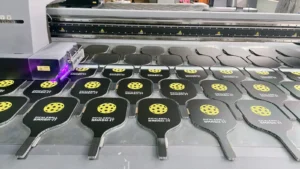
Private-label ball projects usually combine logo placement with a pack format. Confirm the printable area, colour, orientation and acceptable variation on the curved surface before bulk production.
- 3-ball, 6-ball or larger retail pack
- Tube, box, mesh bag or bulk carton
- Barcode and country-specific label area
- Colour and model identification
- Club or event pack quantities
- Master-carton protection and count
If the product will be sold as a set, coordinate the ball pack with pickleball bags and accessories so the contents and packaging dimensions are decided together.
Build a focused wholesale range
A distributor rarely needs every ball type at launch. A simple range might include:
- Main outdoor ball: the dependable, replenishable core SKU.
- Practice ball: a programme or coaching pack with clear use instructions.
- Special-use ball: a silent foam model or LED light-up ball for a defined audience.
This structure keeps the buying story clear and lets reorders reveal where demand actually exists.
Questions to include in a wholesale pickleball RFQ
- Indoor, outdoor, practice or special-use environment
- Selected model, material and hole pattern
- Required colour and quantity per colour
- Logo print requirements
- Retail and master-carton packaging
- Destination market and any model-specific approval requirement
- Order quantity and target delivery timing
Frequently asked questions
Is a 40-hole pickleball always an outdoor ball?
It is a common outdoor format, but hole count alone does not define performance. Confirm the model’s intended use, material and geometry.
Should buyers choose PE or TPE from a datasheet?
No. Use the datasheet to shortlist, then compare physical samples under the expected court and temperature conditions.
Can a silent pickleball replace a standard outdoor ball?
It serves a different use case. Choose it where reduced sound and accessible play matter more than reproducing the response of a hard competition-style ball.
Request the exact model, not a generic ball quote
Request a wholesale pickleball quote with the playing environment, model, material, colour, quantity, logo and packaging. That gives the supplier enough information to recommend and price the correct product.
3 滚动条 (disabled, settable, float) 0.1851851791143417 4 滚动条 (settable, float) 0 5 值指示器 (settable, float) 0 6 增箭头按钮 7 减箭头按钮 8 增页面按钮 9 减页面按钮 10 关闭按钮 11 全屏幕按钮 Help: 此按钮也可以执行缩放窗口的操作, Secondary Actions: 缩放窗口 12 最小化按钮 13 菜单按钮 (disabled) 文稿操作 14 图像 wholesale-pickleballs-buying-guide.txt 15 文本 wholesale-pickleballs-buying-guide.txt 16 menu bar 17 文本编辑 18 文件 19 编辑 20 格式 21 显示 22 窗口 23 帮助The focused UI element is 2 文本输入区 (settable) ID: First Text View, Value:Choose a wholesale pickleball by its intended playing environment first, then compare material, hole pattern, visibility, durability and packaging. A tournament-style outdoor ball, an indoor practice ball and a quiet foam ball solve different customer problems. Treating them as interchangeable leads to poor reviews and excess inventory.
Plekin’s pickleball collection includes 40-hole PE and TPE outdoor models, a 48-hole seamless option, a 26-hole practice ball, an LED ball and a PU foam silent ball.
Start with the playing environment
The playing environment determines the first shortlist. Ask whether the ball will be used outdoors, indoors, for club practice, casual play, night events or noise-sensitive locations.
- Outdoor play: prioritize flight stability, visibility and resistance to repeated court impact.
- Indoor play: choose a pattern and response appropriate for a smoother surface and controlled environment.
- Practice programmes: prioritize predictable supply, colour coding and pack efficiency.
- Noise-sensitive play: consider a foam-style silent ball designed for a different sound and impact profile.
- Events and novelty ranges: LED models can create a separate recreational use case rather than replacing a standard competition ball.
PE vs TPE pickleballs
PE and TPE are both used in moulded pickleballs, but buyers should not select by material abbreviation alone. Resin formulation, wall thickness, moulding consistency and post-mould conditioning all influence the finished ball.
PE pickleballs
PE is widely used for seamless outdoor balls and offers a familiar route for clubs, retailers and distributors. The 40-hole seamless PE pickleball is a useful reference when specifying a conventional outdoor product.
TPE pickleballs
TPE formulations can provide a different balance of resilience and feel. Compare the 40-hole TPE outdoor pickleball with a PE sample under the same temperature, court and test routine before deciding.
Ask the supplier to identify the exact model and intended use. A broad material claim does not replace sample testing or model-specific approval information.
What the hole pattern changes
Hole count, diameter and distribution affect airflow and flight. Buyers often use the count as a quick product label, but the geometry matters as much as the number. A 40-hole ball from one mould may not fly exactly like another 40-hole design.
| Model type | Useful buying question | Potential range role |
|---|---|---|
| 40-hole outdoor ball | How does the model perform in the target climate and court conditions? | Main outdoor retail or club SKU |
| 48-hole seamless ball | What problem does the extra-hole pattern solve for the intended buyer? | Differentiated alternative |
| 26-hole practice ball | Is the model intended for controlled practice or a specific indoor use? | Training and programme packs |
| Silent foam ball | Is reduced sound more important than matching a standard hard ball? | Home, community or noise-sensitive play |
Review Plekin’s 48-hole seamless model and 26-hole practice model as distinct use cases rather than simply more or fewer holes.
Evaluate a sample with a repeatable test
A visual check is not enough. Use the same sample size and routine for every candidate model.
- Record dimensions and weight across multiple balls.
- Check roundness, seam appearance and hole consistency.
- Condition samples in the expected playing temperature.
- Compare bounce and flight using the same court and players.
- Inspect for cracking, warping and soft spots after repeated play.
- Repeat the check with the final colour because pigment can be part of the formulation.
If tournament use is required, verify the exact model’s current approval status against the relevant competition rules. Do not assume that approval for one ball covers another material, mould or colour.
Choose colours for visibility and assortment planning
Colour is both a playability and inventory decision. High-visibility colours are common for main SKUs, while secondary colours can support clubs, events or coordinated paddle sets. Too many colours in a first order divide stock and make replenishment harder.
Start with one primary colour for the intended court environment. Add a second only when there is a clear buyer need, such as programme colour coding or a branded set.
Plan logo printing and packaging together
Private-label ball projects usually combine logo placement with a pack format. Confirm the printable area, colour, orientation and acceptable variation on the curved surface before bulk production.
- 3-ball, 6-ball or larger retail pack
- Tube, box, mesh bag or bulk carton
- Barcode and country-specific label area
- Colour and model identification
- Club or event pack quantities
- Master-carton protection and count
If the product will be sold as a set, coordinate the ball pack with pickleball bags and accessories so the contents and packaging dimensions are decided together.
Build a focused wholesale range
A distributor rarely needs every ball type at launch. A simple range might include:
- Main outdoor ball: the dependable, replenishable core SKU.
- Practice ball: a programme or coaching pack with clear use instructions.
- Special-use ball: a silent foam model or LED light-up ball for a defined audience.
This structure keeps the buying story clear and lets reorders reveal where demand actually exists.
Questions to include in a wholesale pickleball RFQ
- Indoor, outdoor, practice or special-use environment
- Selected model, material and hole pattern
- Required colour and quantity per colour
- Logo print requirements
- Retail and master-carton packaging
- Destination market and any model-specific approval requirement
- Order quantity and target delivery timing
Frequently asked questions
Is a 40-hole pickleball always an outdoor ball?
It is a common outdoor format, but hole count alone does not define performance. Confirm the model’s intended use, material and geometry.
Should buyers choose PE or TPE from a datasheet?
No. Use the datasheet to shortlist, then compare physical samples under the expected court and temperature conditions.
Can a silent pickleball replace a standard outdoor ball?
It serves a different use case. Choose it where reduced sound and accessible play matter more than reproducing the response of a hard competition-style ball.
Request the exact model, not a generic ball quote
Request a wholesale pickleball quote with the playing environment, model, material, colour, quantity, logo and packaging. That gives the supplier enough information to recommend and price the correct product.