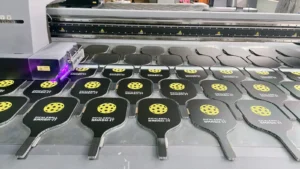
The practical difference between a 13 mm and 16 mm pickleball paddle is how the entire build responds, not thickness alone. A thinner 13 mm core often feels quicker and more direct, while a 16 mm core often feels softer and more controlled. However, face material, core density, shape, perimeter construction and weight distribution can easily reinforce or offset those tendencies.
For a brand or distributor, the decision should begin with target player and product position. Plekin offers customizable paddle thicknesses across a wider range; the custom paddle options page shows the available material, core, shape and finishing choices.
13 mm vs 16 mm at a glance
| Decision factor | 13 mm core | 16 mm core |
|---|---|---|
| General response | More direct and lively | Softer and more damped |
| Typical positioning | Speed and power-oriented | Control and all-round positioning |
| Hand speed | Can feel quicker when the overall build is light | Depends strongly on shape and perimeter weight |
| Player fit | Players who prefer a crisp response | Players who value touch and a steadier response |
| Range role | Performance alternative or attack-focused SKU | Mainstream core model or control-focused SKU |
This table describes common design tendencies. It should not replace physical sample testing.
Why thickness changes paddle response
A paddle core is a structural layer between two faces. Changing its thickness changes the distance between those faces and the amount of material available to deform under impact. In general, a thicker core can create a more muted response, while a thinner core can return energy more immediately.
But two paddles with the same thickness can still play differently. A dense core, stiff face and reinforced perimeter may feel firmer than a softer core with a more flexible face. That is why buyers should compare complete specifications rather than treating “16 mm” as a performance guarantee.
When a 13 mm paddle makes sense
A 13 mm build is useful when the product brief calls for a fast, direct response. It can support a model positioned around quick exchanges, aggressive drives and a crisp impact sensation. For brands, it also provides a clear alternative to the many 16 mm control-oriented paddles already on the market.
- The target player likes a lively, immediate response.
- The line needs a power or speed-focused SKU.
- The shape and balance keep the paddle manoeuvrable.
- The face and perimeter are tuned to prevent the paddle feeling excessively harsh.
Consider a 13 mm option alongside suitable models in Plekin’s pickleball paddle range, then compare samples under the same weight and shape conditions.
When a 16 mm paddle makes sense
A 16 mm core is a versatile starting point for brands targeting broad recreational and intermediate demand. Its softer response can be easier to position around control, touch and confidence. It also works well as the centre of a three-SKU line because the specification is familiar to many buyers.
- The target player prioritizes touch and placement.
- The product needs a comfortable all-round story.
- The brand wants one core thickness to serve a broad audience.
- The paddle uses a firmer face or thermoformed perimeter that benefits from added damping.
Construction can matter as much as thickness
A 16 mm cold-press paddle and a 16 mm thermoformed paddle are not interchangeable. Cold pressing generally creates a softer, more forgiving structure. Thermoforming creates a more integrated shell that can feel firmer and more responsive. Review Plekin’s cold-press and thermoformed comparison before locking the thickness.
For example, a brand might use a 16 mm cold-press raw carbon model for its control line and a 13 mm thermoformed model for its speed line. The thickness helps explain the difference, but the full construction makes the two SKUs meaningfully distinct.
How to compare 13 mm and 16 mm samples
Ask the factory to hold as many other variables constant as possible. If one sample is elongated and head-heavy while the other is wide-body and light, the test will not isolate core thickness.
- Use the same face material and surface finish.
- Use the same shape, handle length and grip size.
- Set a comparable finished weight range.
- Test the same ball type in the same environment.
- Collect feedback on serve, drive, reset, block and hand speed.
- Record preferences by player level rather than averaging every tester together.
The goal is not to prove that one thickness is universally better. It is to identify which build better fits the customer segment you intend to sell.
Build thickness into a clear product line
Too many near-identical thickness options can confuse retailers and customers. Give each SKU a distinct role:
- 13 mm speed model: quick response, lighter handling and an attack-focused message.
- 16 mm control model: softer response, touch and broad all-round use.
- 16 mm premium model: upgraded face or thermoformed construction for buyers who want both stability and performance.
Keep graphics and naming consistent enough that the family looks connected, while using colour and specification labels to make the differences obvious.
Questions to include in your RFQ
- What core material and density are used?
- Is the quoted thickness nominal or finished?
- What finished weight tolerance is available?
- Which face and perimeter options suit each thickness?
- Can both samples use the same shape and components?
- What is the MOQ per thickness, colourway and graphic?
If you are testing multiple thicknesses, the MOQ planning guide explains how shared shapes and stock components can reduce first-order risk.
Frequently asked questions
Is 16 mm always better for control?
No. It commonly supports a softer, more controlled response, but face stiffness, core density, shape and weight distribution remain important.
Is 13 mm only for advanced players?
No. Some recreational players prefer its direct feel and quick handling. Position the product by actual sample feedback, not by thickness alone.
Should a new brand launch both thicknesses?
Only if each serves a clear customer need. A focused first launch with one well-tested specification is often easier to market and reorder.
Turn the target player into a specification
Share the target player, construction, face material, shape, weight range, price position and quantity when requesting samples. Contact Plekin Sports to compare 13 mm and 16 mm builds against one clear product brief.
3 滚动条 (disabled, settable, float) 0.1851851791143417 4 滚动条 (settable, float) 0 5 值指示器 (settable, float) 0 6 增箭头按钮 7 减箭头按钮 8 增页面按钮 9 减页面按钮 10 关闭按钮 11 全屏幕按钮 Help: 此按钮也可以执行缩放窗口的操作, Secondary Actions: 缩放窗口 12 最小化按钮 13 菜单按钮 (disabled) 文稿操作 14 图像 13mm-vs-16mm-pickleball-paddles.txt 15 文本 13mm-vs-16mm-pickleball-paddles.txt 16 menu bar 17 文本编辑 18 文件 19 编辑 20 格式 21 显示 22 窗口 23 帮助The focused UI element is 2 文本输入区 (settable) ID: First Text View, Value:The practical difference between a 13 mm and 16 mm pickleball paddle is how the entire build responds, not thickness alone. A thinner 13 mm core often feels quicker and more direct, while a 16 mm core often feels softer and more controlled. However, face material, core density, shape, perimeter construction and weight distribution can easily reinforce or offset those tendencies.
For a brand or distributor, the decision should begin with target player and product position. Plekin offers customizable paddle thicknesses across a wider range; the custom paddle options page shows the available material, core, shape and finishing choices.
13 mm vs 16 mm at a glance
| Decision factor | 13 mm core | 16 mm core |
|---|---|---|
| General response | More direct and lively | Softer and more damped |
| Typical positioning | Speed and power-oriented | Control and all-round positioning |
| Hand speed | Can feel quicker when the overall build is light | Depends strongly on shape and perimeter weight |
| Player fit | Players who prefer a crisp response | Players who value touch and a steadier response |
| Range role | Performance alternative or attack-focused SKU | Mainstream core model or control-focused SKU |
This table describes common design tendencies. It should not replace physical sample testing.
Why thickness changes paddle response
A paddle core is a structural layer between two faces. Changing its thickness changes the distance between those faces and the amount of material available to deform under impact. In general, a thicker core can create a more muted response, while a thinner core can return energy more immediately.
But two paddles with the same thickness can still play differently. A dense core, stiff face and reinforced perimeter may feel firmer than a softer core with a more flexible face. That is why buyers should compare complete specifications rather than treating “16 mm” as a performance guarantee.
When a 13 mm paddle makes sense
A 13 mm build is useful when the product brief calls for a fast, direct response. It can support a model positioned around quick exchanges, aggressive drives and a crisp impact sensation. For brands, it also provides a clear alternative to the many 16 mm control-oriented paddles already on the market.
- The target player likes a lively, immediate response.
- The line needs a power or speed-focused SKU.
- The shape and balance keep the paddle manoeuvrable.
- The face and perimeter are tuned to prevent the paddle feeling excessively harsh.
Consider a 13 mm option alongside suitable models in Plekin’s pickleball paddle range, then compare samples under the same weight and shape conditions.
When a 16 mm paddle makes sense
A 16 mm core is a versatile starting point for brands targeting broad recreational and intermediate demand. Its softer response can be easier to position around control, touch and confidence. It also works well as the centre of a three-SKU line because the specification is familiar to many buyers.
- The target player prioritizes touch and placement.
- The product needs a comfortable all-round story.
- The brand wants one core thickness to serve a broad audience.
- The paddle uses a firmer face or thermoformed perimeter that benefits from added damping.
Construction can matter as much as thickness
A 16 mm cold-press paddle and a 16 mm thermoformed paddle are not interchangeable. Cold pressing generally creates a softer, more forgiving structure. Thermoforming creates a more integrated shell that can feel firmer and more responsive. Review Plekin’s cold-press and thermoformed comparison before locking the thickness.
For example, a brand might use a 16 mm cold-press raw carbon model for its control line and a 13 mm thermoformed model for its speed line. The thickness helps explain the difference, but the full construction makes the two SKUs meaningfully distinct.
How to compare 13 mm and 16 mm samples
Ask the factory to hold as many other variables constant as possible. If one sample is elongated and head-heavy while the other is wide-body and light, the test will not isolate core thickness.
- Use the same face material and surface finish.
- Use the same shape, handle length and grip size.
- Set a comparable finished weight range.
- Test the same ball type in the same environment.
- Collect feedback on serve, drive, reset, block and hand speed.
- Record preferences by player level rather than averaging every tester together.
The goal is not to prove that one thickness is universally better. It is to identify which build better fits the customer segment you intend to sell.
Build thickness into a clear product line
Too many near-identical thickness options can confuse retailers and customers. Give each SKU a distinct role:
- 13 mm speed model: quick response, lighter handling and an attack-focused message.
- 16 mm control model: softer response, touch and broad all-round use.
- 16 mm premium model: upgraded face or thermoformed construction for buyers who want both stability and performance.
Keep graphics and naming consistent enough that the family looks connected, while using colour and specification labels to make the differences obvious.
Questions to include in your RFQ
- What core material and density are used?
- Is the quoted thickness nominal or finished?
- What finished weight tolerance is available?
- Which face and perimeter options suit each thickness?
- Can both samples use the same shape and components?
- What is the MOQ per thickness, colourway and graphic?
If you are testing multiple thicknesses, the MOQ planning guide explains how shared shapes and stock components can reduce first-order risk.
Frequently asked questions
Is 16 mm always better for control?
No. It commonly supports a softer, more controlled response, but face stiffness, core density, shape and weight distribution remain important.
Is 13 mm only for advanced players?
No. Some recreational players prefer its direct feel and quick handling. Position the product by actual sample feedback, not by thickness alone.
Should a new brand launch both thicknesses?
Only if each serves a clear customer need. A focused first launch with one well-tested specification is often easier to market and reorder.
Turn the target player into a specification
Share the target player, construction, face material, shape, weight range, price position and quantity when requesting samples. Contact Plekin Sports to compare 13 mm and 16 mm builds against one clear product brief.